

Building Enterprise AI Agents: Technical Implementation
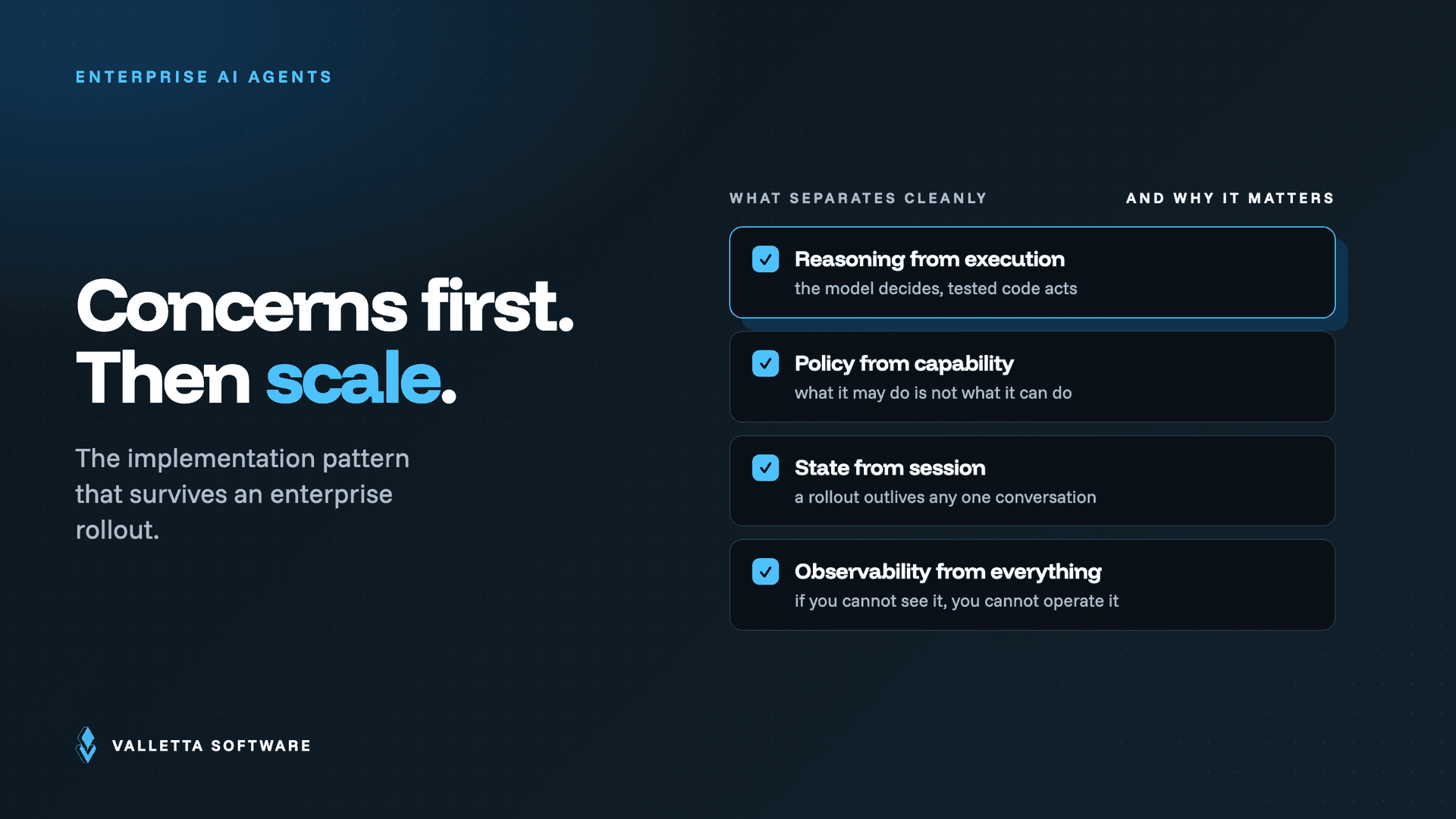

Building enterprise AI agents that actually survive production is harder than building demo agents that look impressive in a sales call. The architectures, evaluation pipelines, and security patterns that make the difference are not exotic, but they are specific. This guide walks through the practical implementation patterns we use to take enterprise AI agents from prototype to production.
Key takeaways
- A three-layer architecture (assistants, functional agents, tools) is the most reliable pattern for enterprise AI agents. It separates concerns cleanly and scales operationally.
- Evaluation is the hardest part of enterprise AI agents, not the model integration. Plan for it from day one.
- Security perimeter is broader than in traditional applications. The agent's tool access is effectively a new attack surface.
- Cost discipline (token budgeting, model routing, caching) determines whether the agent is economically viable at scale.
- Human-in-the-loop is not a fallback, it is a design pattern. The decision of when to defer to humans is itself part of the agent's behavior.
The three-layer architecture
Most successful enterprise AI agent systems converge on a three-layer architecture. The reasoning is operational: each layer has different change frequency, different failure modes, and different audit requirements.
- Layer 1: Assistants. User-facing conversational surfaces. Handle natural language input, maintain conversation state, and route requests to functional agents. Change frequently as UX evolves.
- Layer 2: Functional agents. Specialized agents for specific business capabilities (a contracts agent, an analytics agent, an operations agent). Maintain domain context, orchestrate tool calls, manage retries and error handling. Change moderately as business capabilities evolve.
- Layer 3: Tools. Concrete API calls and data access functions. CRUD operations against business systems, third-party integrations, internal database queries. Change rarely; each tool change requires regression testing across the agents that use it.
The separation lets you update the assistant UI weekly without retesting tool security boundaries, and update tool implementations without re-evaluating every assistant behavior. The cost is some indirection and complexity, but the operational payoff is large.
Evaluation: the hardest part nobody talks about in demos
Building an agent that works on the first ten test queries is easy. Building one that works reliably on the ten thousand queries you cannot anticipate is the actual engineering problem. Evaluation infrastructure is what separates the two.
A production-ready evaluation pipeline has four components:
- A curated test set of 200 to 2,000 representative queries with expected outcomes. Built and maintained by domain experts, not just engineers.
- Automated grading that runs against the test set on every prompt or model change. Mixed approach: deterministic checks for tool calls, LLM-as-judge for response quality.
- Production sampling: roughly 1 to 5% of live queries are reviewed by humans for quality, edge cases, and regressions. The feedback feeds back into the test set.
- A regression dashboard tracking grade trends over time. Spikes indicate either model drift or prompt issues; both warrant immediate attention.
The investment is significant. Roughly 25% of the engineering effort on a serious enterprise AI agent project goes into evaluation infrastructure. Teams that skimp here ship agents that look good in demos and behave unpredictably in production.
Security: agents as a new attack surface
An AI agent with the ability to call tools is effectively a programmable client with access to your systems. That makes it a target. Three security patterns are non-negotiable:
- Least-privilege tool access. Each agent has the narrowest possible set of tools needed for its function. A contracts agent does not need access to the payroll database, even if both exist in the same backend.
- Prompt injection defenses. Treat all user-provided content as potentially adversarial. Use structured prompt formats that separate instructions from data, and validate tool call parameters before execution.
- Full audit logging. Every tool call by an agent is logged with the originating user, the conversation context, the agent that made the call, and the tool's response. Required for compliance, essential for debugging.
For categorized risks specific to AI development, our AI risk register covers the broader picture. For OpenClaw security patterns specifically, see OpenClaw security 2026.
Cost discipline: token budgeting and model routing
Naive enterprise AI agent implementations send every request to the largest available model with full context. This works at demo scale and becomes a margin problem at production scale. Three cost disciplines that make the economics work:
- Model routing. Easy queries go to smaller, cheaper models. Complex queries go to larger models. The routing decision itself is made by a fast classifier (often a small model running locally). Typically cuts inference cost by 60 to 80% with minimal quality loss.
- Prompt caching, where supported by the model provider. Repeated system prompts and tool definitions can be cached, saving tokens on every call.
- Context window management. Send only what is actually needed for the current step, not the full conversation history every time. Compress older context with summarization when needed.
Token budgeting per query is also worth tracking as an operational metric. Setting a soft limit on tokens per interaction (say, 8,000 tokens combined input and output for a typical query) catches runaway behavior early.
Human-in-the-loop as a design pattern
The decision of when an agent should defer to a human is a first-class design decision, not a fallback. Two patterns work in production:
Confidence-based routing. The agent computes a confidence score for its proposed action (based on retrieval scores, reasoning chain stability, or explicit self-evaluation prompts). Below a calibrated threshold, the agent surfaces options to a human rather than acting.
Risk-based escalation. Categories of actions (financial transactions above a threshold, customer-facing communications, regulatory compliance decisions) always require human approval regardless of agent confidence. This is policy, not capability.
The combination produces an agent that acts autonomously where it can and defers where it should. The split is what makes the agent both useful and trustworthy.
Observability for production agents
An enterprise AI agent in production needs observability that covers four layers:
- Conversation health: completion rates, user satisfaction signals, conversation length distributions.
- Agent behavior: tool call frequency, retry rates, reasoning chain length, deferral rate to humans.
- Infrastructure: token consumption, model latency by percentile, error rates from model providers.
- Business outcomes: tickets resolved, automations completed, time saved per interaction.
Tying all four together in one dashboard, where you can correlate a spike in user dissatisfaction with a model latency event or a tool failure, is what makes the agent operable. Treating these as separate concerns produces a system where each team owns part of the picture and no one owns the whole.
Where to start: a six-week roadmap
For an organization starting an enterprise AI agent project from scratch, the six-week sequence we recommend:
- Week 1 to 2: scope and use-case definition. Pick one bounded business capability where AI agents have clear value and measurable outcomes. Build the test set (200 queries) before any code.
- Week 3 to 4: technical implementation. Build the three-layer architecture for the single use case. Implement evaluation pipeline in parallel.
- Week 5: security review, audit logging, human-in-the-loop integration. Run the agent against the test set; iterate on prompts and tool calls.
- Week 6: limited production rollout to a subset of users. Begin production sampling. Establish operational rhythm before expanding scope.
For a deeper view of use cases and patterns by industry, see AI agents business use cases, our AI agents platform overview, and enterprise AI agent case studies. For implementation reference material, see Anthropic's tool-use documentation and LangGraph documentation.
Frequently asked questions
Should we build on a framework like LangGraph or Crew, or roll our own?
For most enterprise teams, start with a framework (LangGraph, AutoGen, or your model provider's agent SDK). The frameworks handle conversation state, tool invocation, and retry patterns reasonably well. Roll your own only if you have specific requirements the frameworks cannot meet, and budget extra engineering time accordingly.
How do you handle hallucinations in tool calls?
Two layers. First, validate tool call parameters before execution against an explicit schema. Reject malformed calls with explanatory error messages that the agent can recover from. Second, add post-execution checks: if the tool returned an obviously wrong result (empty when it should not be, format violations), surface that to the agent before continuing.
What is the typical cost to build an enterprise agent system?
For a single bounded use case to production-grade, plan on USD 80k to 180k of engineering effort over 6 to 12 weeks, plus ongoing inference costs that depend heavily on usage volume. Expansion to additional use cases is significantly cheaper once the three-layer infrastructure is in place.
Can agents work with on-premises models?
Yes. Models like Llama, Qwen, and Mistral in their larger variants are capable enough for many enterprise agent use cases by 2026. The trade-offs are higher infrastructure cost (you run the inference) and more operational complexity (you manage scaling, model updates, evaluation). For data residency or compliance reasons, on-premises is often the right choice despite the trade-offs.
What is the single most common cause of enterprise AI agent project failure?
Scope sprawl. Projects start with one well-defined use case and gradually grow into "the AI assistant that does everything." Each added capability dilutes evaluation effort, increases security surface, and reduces overall reliability. Successful projects stay narrow and add capabilities only after the existing ones are operationally stable.